Human Bingo Card Generator (Find Someone Who)
Make human bingo cards for an icebreaker: each square describes a person, and guests write a name in the line below it.
Recent
Your last 10 settings, saved only in this browser. Nothing is uploaded.
Human bingo is a mingling game where each square describes a person, and players find someone who matches and write that person’s name in the square. This page has a free bingo card generator that runs in your web browser. There is no sign-up, and nothing is uploaded: your cards are made on your own device.
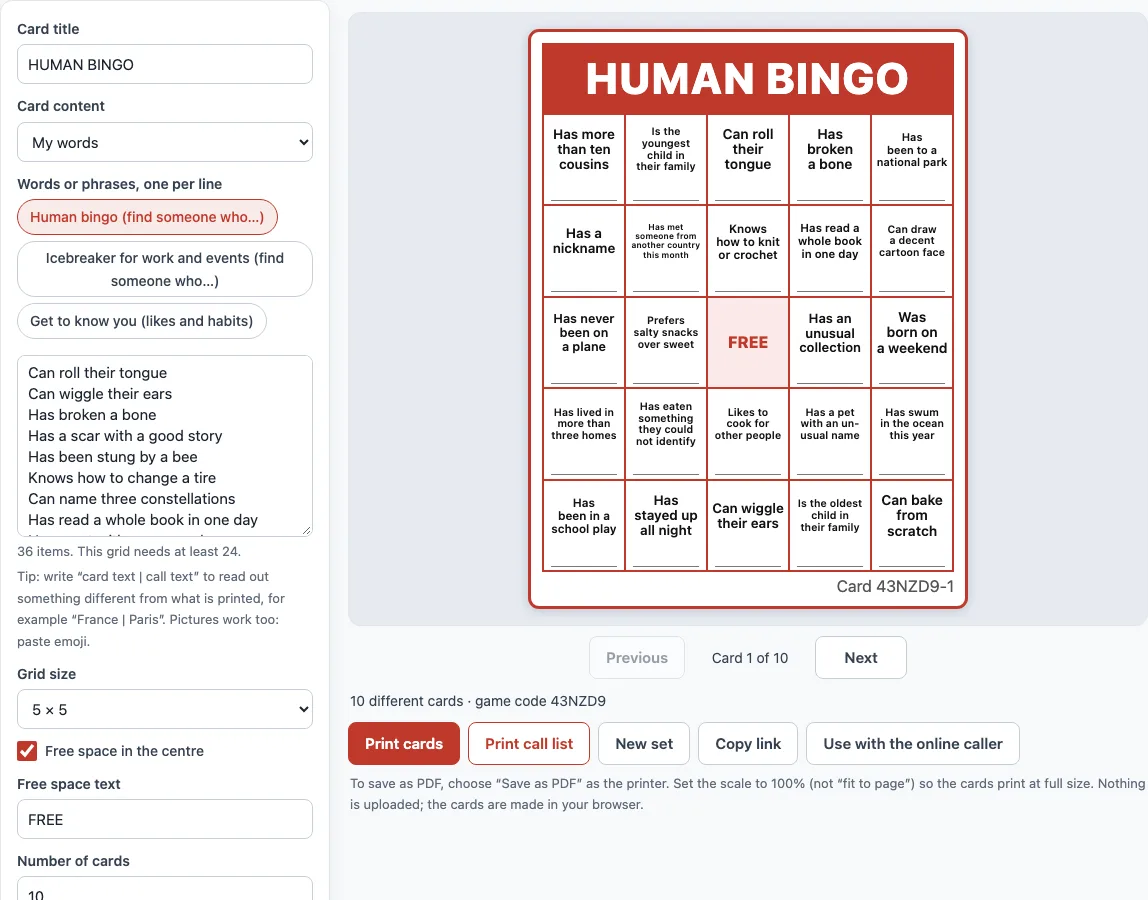
The page opens with a human bingo word list already loaded, so you can print cards straight away. You can change the squares, choose a grid size, and make any number of cards from 1 to 500. Each card in a set is different. Every square has a blank line under the words, where the guest writes the name of the person who matches.
How to make human bingo cards
- Open this page. It starts in “My words” mode with the human bingo list loaded.
- To use a different list, click one of the preset buttons above the word box: the general human bingo list, the work and events list, or the likes and habits list.
- Edit the word box if you want. Use one trait per line, and add or delete items as you like.
- Choose a grid size: 3 × 3, 4 × 4 or 5 × 5. For 3 × 3 and 5 × 5, you can switch on the free space in the center and change its text (the default is FREE).
- Set the number of cards, from 1 to 500. The default is 10.
- Keep the “Leave a line in each square for a name” box ticked. It is on by default.
- Set the card title, paper size (US Letter or A4), cards per page, color and any optional extras, such as the letters row or card number.
- Use the Previous and Next buttons to check the cards in the preview.
- Click “Print cards”. To make a PDF, choose “Save as PDF” in the print dialog and set the scale to 100%, not “fit to page”.
Copy link saves your exact cards and word list, so the same link opens them again. New set makes fresh random cards with a new game code. For handwriting, print one card per page.
What is human bingo?
Human bingo is a mingling game with no caller. Each square describes a trait a person can have, such as “Can roll their tongue” or “Has lived abroad”, and the squares are written so a stranger can answer yes or no quickly. Players walk around, ask each other questions, and write a matching person’s name in a square. The game is also called find someone who bingo, people bingo, icebreaker bingo (sometimes written bingo ice breaker) or get to know you bingo.
The usual rules are set by the host. A common rule is that each person can sign a card only once, so a name appears just once on a card. The first player to fill a line shouts “Bingo”. Many groups then play on for four corners or the whole card. A common extra step is to ask the winner to introduce two people whose names are on their card.
What squares make a good human bingo card?
A good square is short, easy to check and safe to ask a stranger. “Can roll their tongue” works because the other person can answer at once and even show you. “Has lived abroad” starts a conversation, which is the point of the game. Avoid squares about money, health or family troubles, and avoid anything that would single out one person in a small group.
Match the squares to the group. A class of children does well with simple traits such as hobbies, pets and favorite foods. Colleagues who already know each other can use squares about careers, commutes and side projects. A mix of easy squares that many people match and a few rare ones keeps the game moving, because players can fill several squares early and still hunt for the last one.
How many people do you need for human bingo?
When each guest can sign a card only once, you need at least as many other people as there are squares to fill. A 5 × 5 card with a free space needs at least 24 other people. A 4 × 4 card needs 16, and a 3 × 3 card with a free space needs 8. Without a free space, a 3 × 3 card needs 9 people and a 5 × 5 card needs 25.
For a small group, choose a smaller grid. The number of possible cards is large, too. The 36 general squares make 1,251,677,700 different 5 × 5 sets of 24 squares, so players are unlikely to end up with the same card.
Frequently asked questions
How to play human bingo
Give everyone a card and a pen. Players walk around and ask others questions to find someone who matches a square. When they find a match, they write that person’s name in the square. If the rule is one signature per person, players must talk to many different people.
How do I win human bingo?
Agree on the winning pattern before you start. Most groups use the first full line, shouted as “Bingo”. Others play for four corners or a full card. The winner can be asked to introduce two people whose names are on their card.
What squares should I use for human bingo?
Use the preset list that fits your group, then edit it. Keep one trait per line and make each square short enough to fit beside a name line. Add squares about your own group, such as a class or team, and delete any that feel too personal.
Is there get to know you bingo for adults and work teams?
Yes. The “Icebreaker for work and events” list includes squares such as “Works in a different team than you” and “Has a mentor”. The “Get to know you” list suits adults who want to find things they have in common, such as “Plays board games” or “Keeps a journal”.
Do I need a caller for human bingo?
No. Human bingo has no caller. Players move around the room and find matches themselves, so you only need the printed cards.
Related tools
- Party bingo — Use it for a game night or celebration with a mix of guests.
- Classroom bingo — Use it for a school lesson or a start-of-term activity.
- Office bingo — Use it for a team meeting or a workplace social event.
- Family bingo — Use it for relatives or a family gathering.
- Kindness bingo — Use it when you want players to do small acts of kindness.
- Birthday bingo — Use it for a birthday party with a theme.
- Virtual bingo — Use it when players join from different places online.
- Bingo card template — Use it when you want a blank layout to fill in by hand.